On July 9th, the House passed H.5562, An Act Relative to Economic Development in the Commonwealth, a $561 million economic development bill with 260 outside policy sections. The bill is $256 million (84 percent) more than the Governor’s economic development bill, the Mass Wins Act, and has 143 additional outside policy sections. While the House did not include several notable provisions from the Governor’s bill and introduced new proposals, the House retains the authorizations proposed by the Governor and includes several of the administration’s more notable policy proposals.
On April 16th, 2026, the Healey-Driscoll administration filed an economic development bill, titled An Act Relative to Massachusetts Winning Global Investment, Talent, and Innovation, or the Mass Wins Act. The bill includes $305 million in capital authorizations and 120 outside policy sections. According to the administration, the bill has several themes: enhancing Massachusetts’ competitiveness, reducing barriers and streamlining housing production efforts, and coordinating the state’s climatetech investments.
On July 31st, 2025, Governor Healey filed H.4375, An Act to preserve and advance Massachusetts’
competitiveness in discovery, research, and innovation for a vibrant economy, which proposes a $400
million investment in the state’s research and development sector in response to federal grant funding
cuts and delays. The House and Senate have incorporated certain provisions of the Governor’s bill, but
their approach and funding amounts vary.
The Mass Ready Act, a $3.1 billion environmental bond bill, was filed by the Healey-Driscoll administration on June 24th. The legislation proposes a new five-year capital plan and a series of policy initiatives aimed at improving climate resilience, protecting natural resources, and expanding access to open space.
Improving the state’s business climate is going to take time — a luxury we might not have if the economy keeps losing steam.
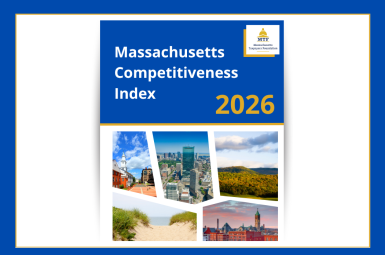
This is the second installment of the MTF Competitiveness Index, which is designed to provide residents, employers, and policymakers with a holistic assessment of how Massachusetts compares to our regional and economic competitor states across 27 different metrics in four categories of competitiveness:

LOOK CLOSELY at how Massachusetts is growing, and a pattern emerges. It’s visible in the families opening small businesses in places like Lawrence and Springfield, in the surge of young workers entering fields like health care, construction, and climate tech, and in the numbers: Nearly 80 percent of the state’s population growth over the last decade came from Hispanic/Latino residents, along with more than $30 billion in added economic output.
The state’s UI system is still feeling the impact of significant unemployment during the pandemic, which resulted in thousands of additional individuals receiving UI benefits for an extended period. By April 2020, the state’s unemployment had skyrocketed to 17.8 percent, growing more than fivefold from the 3.1 percent rate just two months earlier (in February 2020).
In spite of unanimous passage by both the House and the Senate, in the final days of the legislative session a compromise economic development bill failed to reach the Governor’s desk. While the two versions of the bill differ significantly on policy proposals, the framework for both bills is the same: authorizing capital spending that supports the state’s five-year economic development plan, continuing the state’s successful life sciences initiative, and creating a similar initiative for climate tech.
And that, according to the Massachusetts Competitiveness Index Report released Tuesday by the Massachusetts Taxpayers Foundation, UMass Amherst Donahue Institute and Massachusetts Competitive Partnership, has been our high-wage, high-knowledge industries, stemming from the historically close ties between its education system and economy.