This November, voters in Massachusetts may be asked to approve or reject a number of proposals that either create new or amend existing state laws. These proposals, known as initiative petitions, are currently under consideration by the State Legislature. If the Legislature does not take action on a petition, it is placed before voters for their consideration.
April 18, 2024
BUDGET & TAXES > Budget > FY 2025
FY 2025 House Amendments By the Numbers
5 Things to Know:
1. House members filed 1,495 amendments, 71 fewer than in FY 2024 and 27 fewer than in FY 2023.
2. The fiscal impact of all amendments is $2.02billion.*
3. Over 70% (1,095) of the amendments are earmarks.
4. Approximately 25%(400) of the amendments are outside policy sections, support programmatic funding increases, or introduce new line-item language.
5. Between FY 2022 – FY 2024, an average of $108 million in additional spending was added during House Debate.
April 10, 2024
BUDGET & TAXES > Budget > FY 2025
House Ways & Means Fiscal Year 2025 Budget
Earlier today, the Fiscal Year (FY) 2025 budget development process officially moved to the Legislature with the release of the House Committee on Ways and Means (HWM) budget proposal. About two months after Governor Healey filed her administration’s spending plan, the $57.98 billion HWM budget makes notable investments in transportation, K-12 education, and housing.
March 18, 2024
BUDGET & TAXES > Budget > FY 2025
Fiscal Year 2025 Budget: Revenue & Resources

On January 24th, the Healey administration filed its budget proposal for Fiscal Year (FY) 2025. The $58.13 billion spending plan is supported by tax, departmental, and federal revenues, as well as the use of trust fund resources built up in recent years.
February 23, 2024
BUDGET & TAXES > Budget > FY 2025
Fiscal Year 2025 Budget: Surtax Spending
On January 24th, the Healey administration filed its budget proposal for Fiscal Year (FY) 2025. The $58.13 billion spending plan includes $1.3 billion in proposed spending supported by income surtax revenues, an increase of $300 million over the $1 billion surtax spending cap established for the FY 2024 General Appropriations Act (GAA).
February 14, 2024
BUDGET & TAXES > Budget > FY 2025
Fiscal Year 2025 Budget: Local Aid & K-12 Education Funding

On January 24th, the Healey administration filed its budget proposal for Fiscal Year (FY) 2025. The $58.13 billion spending plan included critical investments in child care, healthcare, and transportation; as well as sizeable increases in support for local aid to cities and towns and K-12 education.
January 24, 2024
BUDGET & TAXES > Budget > FY 2025
Governor Healey’s Fiscal Year 2025 Budget
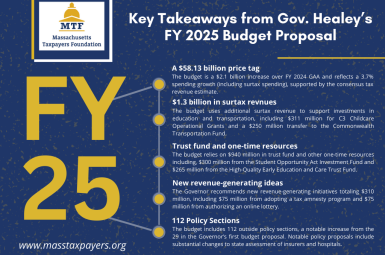
Earlier today, the Healey-Driscoll administration released its Fiscal Year (FY) 2025 budget proposal. The $58.13 billion spending plan includes critical investments in childcare, education, and transportation; and $1.3 billion in spending supported by income surtax revenues. The Governor’s budget increases funding over the FY 2024 General Appropriations Act (GAA) by $2.1 billion (3.7 percent); a rate of growth that reflects the modest revenue expectations for the upcoming fiscal year.
January 11, 2024
BUDGET & TAXES > Budget > FY 2024
MTF Analysis of FY 2024 Tax Revenue Shortfall & 9C Cuts
Earlier this week, the Healey administration announced a $1 billion tax revenue shortfall for FY 2024, downgrading the revenue benchmark from $40.41 billion to $39.41 billion. They also released a plan to solve the shortfall which includes approximately $375 million in net mid-year (9C) budget cuts. In total, 66 budget line-items were reduced by $545 million in gross spending. These cuts are accompanied by approximately $169 million in lost revenue, resulting in an estimated net impact of $375 million.
January 08, 2024
BUDGET & TAXES > Budget > FY 2025
FY 2025 Consensus Tax Revenue Agreement

On January 8th, budget leaders from the House, Senate, and Administration announced a $40.202 billion consensus tax revenue figure for the Fiscal Year (FY) 2025 budget, excluding surtax revenue. Budget writers expect tax revenues to grow by $792 million (2 percent) over estimated FY 2024 collections of $39.410 billion (Figure 1). The consensus tax revenue agreement also establishes a $1.3 billion cap on the use of income surtax revenues in the FY 2025 budget, a $300 million increase over the amount of surtax-supported spending in FY 2024.
The Healey Administration announced a $1 billion revenue shortfall, attributable to below benchmark revenue collections to date.
- The FY 2024 revenue benchmark has been downgraded to $39.410 billion.
- After accounting for the shortfall and the impacts of tax relief, expected FY 2024 revenue collections total $38.833 billion.
Authored by: Meaghan Callahan